What two years of textile PEF taught us about footprint scores
Guest article by Camilla Mjelde, Sustainability and Compliance Director, Trimco Group
On 12 and 13 November 2026, the working group CEN/TC 248/WG 39 "Circular Economy for textile products and the textile chain" held its 20th plenary meeting in Sandefjord, Norway. The agenda covered a lot of ground: updates on EU textile legislation, work on circular design, sorting specifications and recycled input materials, and a visit to Norsk Tekstilgjenvinning's fibre-to-fibre recycling plant. Trimco's contribution centered on one question: when the same garment receives different environmental scores depending on the method, which one should our industry support in the quest for circularity?
The meeting was hosted by NEN together with Standard Norge and its mirror committee SN/K 621, Circular value chains for textiles. Delegates from Germany, France, the Netherlands, Portugal, Italy, Spain and all the Nordic countries took part, in the room and online. Trimco Group presented on both days, and my colleagues Marie Verheule and Magdalena Solli joined me to document the sessions and the factory visit.
Day 1: one product, four methods
Our first presentation compared the impact score of the same apparel products under four approaches: PEFCR 3.11, the French Ecobalyse tool, and the two proposals for a simplified PEF in the JRC’s 3rd Milestone. The results build on a two-year PEF and LCA project with Norwegian brands, supported by NF&TA, the Norwegian cluster for fashion and textiles. Our preliminary findings show that the same product can score differently depending on the method. For a brand, that difference reaches the design table: a fiber or supplier choice that looks favorable under one method can look less favorable under another. For consumers, it reaches the point of purchase if different markets show different scores for the same garment. The response in the room was strong. Several stakeholders said the results should be shared with the JRC, the Commission's science service that is developing the simplified PEF. A second point was raised by participants: brands that invest in LCA and PEF calculations should see that effort rewarded through eco-modulated fees under the coming textile EPR schemes.
The policy picture
Day 1 also covered the latest political timelines for EU textile legislation: the Textile Labelling Regulation (TLR), the delegated act, end-of-waste criteria, the Green Claims Directive and Green Public Procurement. The Textile Labelling Regulation drew the most discussion. Participants indicated that its scope may be reduced and that the regulation is now expected later than first planned. For Trimco Group, the key question is where the Ecodesign for Sustainable Products Regulation (ESPR), with its Digital Product Passport (DPP), meets the TLR. We aim to balance the digital requirements with the physical printed label. There are high expectations and hopes around reducing physical labels in favour of digital labelling. This balance will be set through the TLR and the ESPR, and clarity here will help our whole industry plan ahead.
Day 2: fibre to fibre in Sandefjord
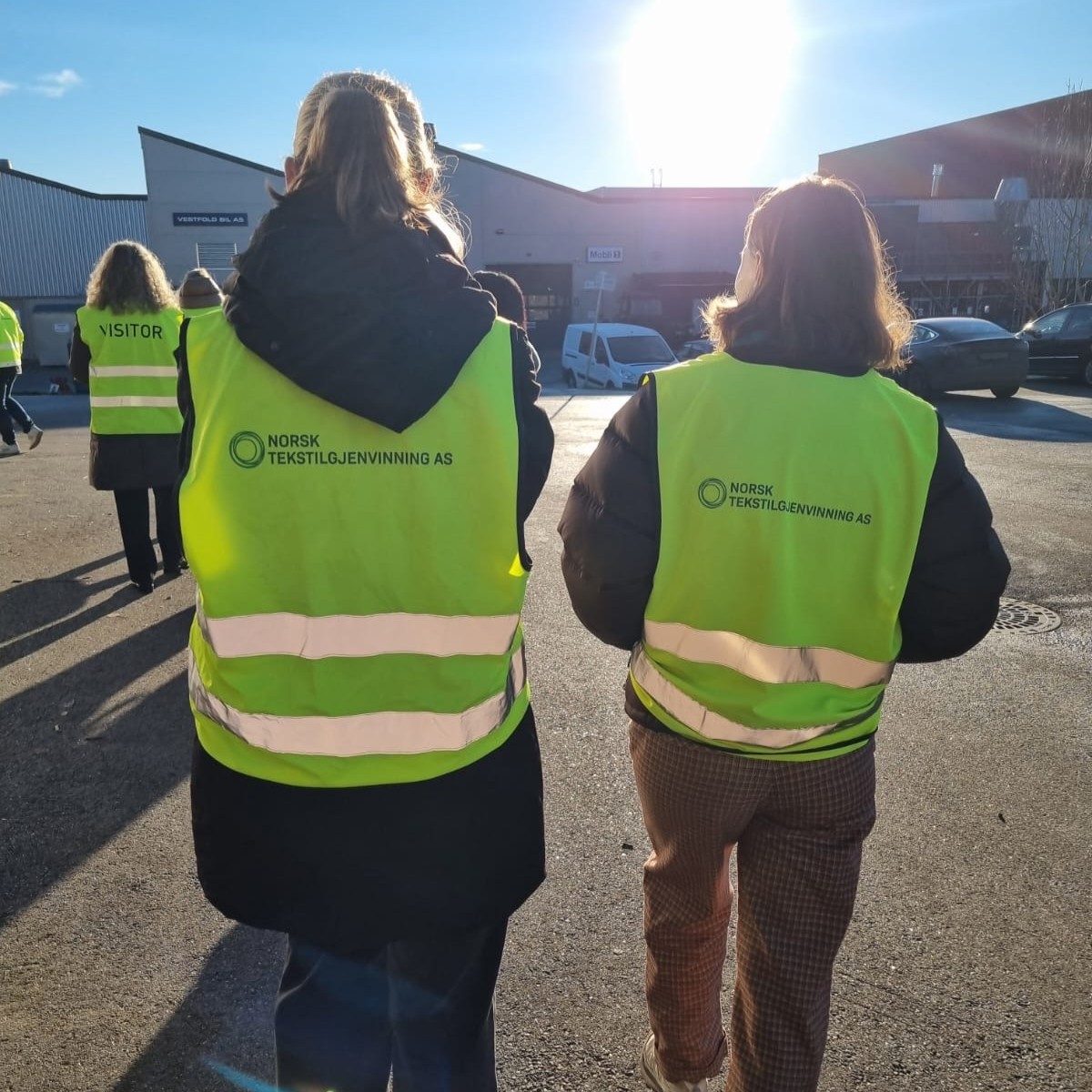
We started the second day at Norsk Tekstilgjenvinning (NTG), Norway's first textile-to-textile recycling plant, located in Sandefjord. We saw fibre-to-fibre recycling running in a closed loop and visited the R&D lab. The visit showed how much research sits behind each bale of recycled fibre, from sorting by fibre content to testing whether the fibre can be spun into new yarn. The working group's afternoon session on handling and sorting specifications was particularly relevant after the morning’s factory tour. New technology will lead the way for sorting, and it depends on reliable data about what each garment is made of.
A brand's experience with PEF
Back at the meeting, Trimco Group presented a joint session on LCA and its impacts together with Dr Jo Cramer, Associate Professor at OsloMet and research group leader for Fashion.Textiles.Design, and journalist Tone Skårdal Tobiasson, partner in the Textile Compass project. The three perspectives, industry, design research and policy journalism, led to a long discussion with the delegates.
We shared detailed comments from Yngvill Ofstad at Bergans of Norway, gathered during the two-year project with NF&TA and Green Score Capital. Hearing directly how a brand experiences working with PEF gave the working group input it rarely receives. Once again, we were asked to share the presentation with more committees and with the JRC.
The afternoon continued with technical work on circular design and on handling and sorting specifications. The engagement stayed high, but the details became more technical.
Three things I take home
1. The method choice changes the result. Agreeing on how textile footprints are calculated matters as much as the scores themselves, and our industry needs clarity before we redesign products around a number.
2. Measurement deserves recognition. Linking LCA and PEF work to eco-modulated EPR fees would give brands a concrete reason to invest in better circular choices.
3. Circularity is a complex target. We need to accept that this process moves slowly, so that most stakeholders’ views are included and we can agree on a middle way for policy development.
Thank you to Standard Norge, NEN, NTG, NF&TA, Bergans, Jo Cramer and Tone Skårdal Tobiasson for two productive days. If you work with PEF, LCA or label data and want to compare notes, or would like us to present the project results to your brand, get in touch.